|



 |
|
|
Materials of this chapter were published in the book 'Biological product Albit for yield increase and plant protection: trials, recommendations, results of application' edited by member of the Academy V.G. Mineev. All-Russian Scientific Research Institute of Plant Protection, Ministry of Agriculture of the Russian Federation, 2009, and also in the article: Zlotnikov, A.K., Gins, V.K., Zlotnikov, K.M. (2001). Influence of treatment with biostimulant Albit and rhizosphere bacteria Bacillus firmus E3 and Klebsiella terrigena E6 on amaranth growth. Materials of IV International Conference ‘New and non-traditional plants and prospects of their application’, Published by People`s Friendship University of Russia, p. 54-56.
Genus Amaranthus L. relates to division Magnoliophyta, class Magnoliopsida, order Caryophyllales, family Amaranthaceaee. There are 60-90 Amaranth species, 55 of them are most prevalent species. In Russia, 16 species of amaranth growth in the wild nature. Several amaranth species are cultivated: A. blitum, A. caudatus, A. mantegazzianus, A. dubius, A. paniculatus, A. spinosus and A. tricolor. Amaranth species are divided to cereals (for seeds), vegetable (for salads), fodder crop, officinal and decorative plants. On amaranth, Albit is applied as antidote for decreasing the side phytotoxic effect of pesticides. Also, Albit increases the field germination, accelerates growth and development, increases plant resistance to unfavorable conditions of environment, provides the defense against plant diseases, increases the yield of leaf mass and seeds. Application recommendations. It is recommended the soaking of seeds before sowing from 30 minutes (with constant stirring) up to 10 hours (without stirring) in the solution 0.5-4 mL of Albit/L of water. It is more efficient to apply Albit as antidote in tank mix with chemical protectants. A higher dose is applied for increasing the plant resistance to the following spraying of plants with pesticides. Solution of Albit (used for seed treatment) also may be applied into the soil during planting. On amaranth, Albit has been tested since 2000 in field experiments in Moscow and other regions of Russia. Field trials were conducted in All-Russian Research Institute of Vegetable Breeding and Seed Production and also in other institutes and farms. In plot trials of All-Russian Research Institute of Vegetable Breeding and Seed Production in 2000, pre-sowing seed treatment of amaranth Amaranthus paniculatus with Albit had a growth-stimulating effect on plants: increased germination, height of seedlings was by 157% higher than in control, height of plants increased in 2-4 times, the number of true leaves – by 66%. Thus, Albit provided a significant yield increase of green mass (Fig. 1). Also, Albit had a high biological efficiency against root rots (BE 95-100%). It promoted to saving of plants on the early stages of plant development.
Fig. 1. Influence of Albit on development of amaranth. Control – control, Albit – treatment with Albit (All-Russian Research Institute of Vegetable Breeding and Seed Production, 2000)
In the following Table, you may see reports on performance of Albit on amaranth. For all available reports, please see corresponding table on Russian webpage.
|
|
||||||||||||||||||||||||||||||||||||||||||


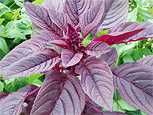 Nowadays,
a new prospective culture, amaranth, is getting more widespread in the farming
practice of many countries. In Russia, it is a new plant for agricultural practice.
At the same time, the examples of a number of foreign countries allow us to
hope that over time the amaranth will take its proper place in agriculture
of Russia.
Nowadays,
a new prospective culture, amaranth, is getting more widespread in the farming
practice of many countries. In Russia, it is a new plant for agricultural practice.
At the same time, the examples of a number of foreign countries allow us to
hope that over time the amaranth will take its proper place in agriculture
of Russia.



 |
Terms and Conditions
|
|