 |
An innovative plant growth promoter for organic and traditional farming
|
 
|
Combination with insecticides |
|


Materials of this chapter were also published in:
- Zlotnikov A.K. Assessment of Albit efficiency in the system of field crops protection against insects / A.K. Zlotnikov, A.T. Podvarko, T.A. Ryabchinskaya, N.A. Kudryavtsev, K.M. Zlotnikov, I.M. Khanieva // Zemledelie. – 2017. – № 4. – P. 37-42. (In Russian)
- Podvarko A.T. Impact of the biopreparation Albit on the resistance of agricultures towards pests / A.T. Podvarko, T.A. Ryabchinskaya, N.A. Kudryavtsev, A.K. Zlotnikov, K.M. Zlotnikov // Vladimirskiy Zemledelets (Vladimir’s agriculturist). – 2017. – № 1 (79). – P. 29-32. (In Russian)
- Zlotnikov, A.K. (2007) Efficiency of Albit jointly used with insecticides on canola. / Zlotnikov A.K., Sergeev V.R., Begunov I.I., Lebedev V.B. // Plant protection and quarantine. Nr. 8, p. 40
- Biostimulant Albit for increasing yields and protection of agricultures against diseases, A.K. Zlotnikov, Ed. Prof. А. Melkumova. All-Russia Institute of Plant Protection, Russia, 2006
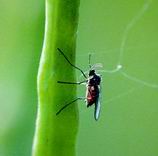 Albit is well-applicable in combination with insecticides,
that visibly reduces insecticide-induced stress effect on treated plants.
Albit is well-applicable in combination with insecticides,
that visibly reduces insecticide-induced stress effect on treated plants.
Insecticides are group of pesticides used to control insect pests. Generally, insecticides are united with acaricides (pesticides against pathogenic mites), since they have the same mechanisms of action. Thus, this group of pesticides can be called insectoacaricides. Sometimes, term 'insecticide' is used as short form of 'insectoacaricide'. Like fungicides and herbicides, insecticides cause considerable stressful effect on plants, that leads to yield losses and decreased yield quality (for example, decreased gluten content). For example, application of insecticide in LLC Agrofirma Anyak (Republic of Tatarstan, Aktanysh region) on the rape var. Ratnik (2010) induced burns, brown and necrosis of leaves, significant growth retardation. After Albit application the stress effect of the insecticide was removed. According to Xiao et al. [1], after application of herbicides, fungicides and insecticides the intensity of photosynthesis in plants reduces by 44-129%, 21-35%, 36-81%, respectively. Organophosphate insecticides may cause plant burns in conditions of open solar insolation [2]. The phytotoxic effect of insecticides based on dinitroorthocresol and 2,4-dinitro-6-methylphenol is specifically used to inhibit the growth of orchards and vineyards (“inhibition of growth”). However, overdose of these products may cause burns of leaves and buds and even destroy the garden [3].
Efficiency of Albit/insecticide combinations was demonstrated in field trials carried out by farms of Krasnodar and Stavropol krais, Vladimir, Nizhniy Novrorod and Rostov oblasts, All-Russia Institute of Plant Protection All-Russia Institute of Biological Plant Protection and Scientific Agricultural Institute of South-East. The results of successful application of Albit with insecticides in farms of Latvia, Romania, USA, Czech Republic, Switzerland were obtained (Table 2). Albit was used with insecticides based on imidacloprid, alpha-cypermethrin, beta-cypermethrin, deltamethrin, dimethoate, difenoconazole, carbofuran, lambda-cyhalothrin, malathion, tebuconazole, thiamethoxam, fipronil, fludioxonil, cypermethrin and others. There have been no cases of incompatibility or decreased efficiency of insecticides used jointly with Albit yet.
Currently, agricultural manufacturers are forced on using more and more of insecticides, in spite of their stressful effects. With the lapse of time, insect pests injure cereal crops more and more. This in jury is not just the mechanical damage of plants: insects (for example, aphids of cereals and swedish fly) are also carriers of viral diseases. It was especially actual in Russia in 2005, when many farmers had to use insecticides for the first time so save yield. Combinations of Albit with insecticides (for example, with diazinon and deltamethrin based ones against cereal aphids and cereal leaf beetle) were also tested.
Apart from the anti-stress effect, the adding of Albit to insecticides enhances their protective effect. Plant immune system is universal and ensures resistance both to biotic (bacteria, fungi, arthropoda pests) and abiotic stresses (extreme temperature, humidity, radiation, pesticide stress). Immunizers causing plant resistance to one pathogens, sometimes can cause cross resistance to another. Biopreparation Albit consists of metabolites of rhizosphere bacteria and has immunizing, adaptogenic, growth-stimulating effects, and antistress activity. Field trials with the biopreparation on cereals (oats, winter wheat), canola, fiber flax in 2006-2012 revealed protective activity of Albit against several species of plant pests. It was established that seed treatment and foliar spraying with Albit increased resistance of oats to Oscinella frit L., Eurigaster integriceps Put., Agromiza mobilis Mg., Phyllotreta vittula Redt. (at biological efficacy level 27–71 %), fiber flax – to Aphthona euphorbiae Schr. (21.1 %), wheat – to Haplothrips tritici Kurd. (19 %), canola – to Phyllotreta nemorum L., Thysanoptera (imago) and Plutella maculipennis Curt. (from 10 to 16.6 %). Albit application in tank mix with insecticides positively influenced not only on biological efficacy of insecticides (efficacy of insecticides increased by 20 % on average), but also on crop yield (increase by 7 to 28 % as compared to pure insecticide). The obtained data allow to conclude that application of Albit with insecticides can be used in minimal recommended or, in some cases, reduced dosages (by 20-25%). This makes it possible to reduce the chemical load on plants while preserving the protective effect. For yield increase and disease resistance, application of Albit with 100% recommended dose of insecticide is also advisable [4].
One good example of such combination efficiency is joint application of Albit with lambda-cyhalothrin based insecticide on spring wheat and barley in Pushkinskoe experimental farm (Nizhniy Novgorod oblast) against leaf miners and flea beetles. Area of field, used in the trial, exceeded 2000 hectares; in 2004 the insecticide was used alone, in 2005 – in combination with Albit. Despite possible differences in plant’s response in different years, one can note positive tendency. Albit did not decreased efficiency of the insecticide, but, due to its immunizing activity, it reduced yield losses caused by diseases (Table 15). Owing to Albit, total yield losses caused by pests and diseases were reduced by 30% (wheat) and 32% (barley) on average. These values almost twice exceeds average yield increase provided by pure Albit on these cultures (16-18%). Therefore, obtained effect might be created also by antistress activity of Albit.
Table 1. Yield losses of cereals caused by diseases and insect pests due to application of lambda-cyhalothrin based insecticide alone (2004) and in combination with Albit (2005) (Pushkinskoe experimental farm)| Crop | Yield losses caused by diseases(Helminthosporium rot, powdery mildew, rusts, root rots), % | Yield losses caused by insect pests (leaf miners, flea beetles), % | ||
| 2004 | 2005 | 2004 | 2005 | |
| Spring wheat (var. Tulaykovskaya, Kurskaya) | 36–43 | 7–10 | 10–15 | 10 |
| Spring barley (var . Ataman , Prima Belorussii) | 35–45 | 6–11 | 8–10 | 5–12 |
It is well known, that application of insecticides against corn-bug suppresses plant growth, transportation of photosynthesis products, reduces synthesis of gluten in grain, decreases yield quality. Combination of insecticides with Albit abolishes this effect, that leads to increase of gluten content in grain by 1.2-4.6% comparing to variant treated with insecticide only. In Rostov oblast (1999-2004) Albit was successfully used in combinations with insecticides against shield-backed bugs in EC stages 50-69. Application of such combination provided abolishment of plant growth suppression effect and stable yield of 45-49 centners/hectare contained 26-29% of gluten having Gluten Deformation Index of 65-95.
High effectiveness of Albit/malathion-based insecticide combination was demonstrated in trial carried out by Vladimir Regional Plant Protection Station on white cabbage (2004).
Albit used in combination with thiamethoxam based insecticide (against Colorado beetle) did not decrease insecticide’s effectiveness (All-Russia Institute of Plant Protection); in contrary, application of the combination even increased total effect of insecticide on yield, possibly, due to relieving insecticide’s toxic influence on plants. Thus, yield increase due to treatment with the insecticide only was 10.6%, whereas treatment with Albit/insecticide combination provided yield of 18.5%. Analogous data on potato were obtained by All-Russia Institute of Plant Protection in experiments on fipronil based insecticide in 2003.
According to data of Scientific Agricultural Institute of South-East (2005, 2006), All-Russia Institute of Plant Protection (2006) and All-Russia Institute of Biological Plant Protection (2006), the highest yield increase due to Albit/insecticide application is demonstrated by canola. In trials, insecticides based on alpha-cypermethrin, deltamethrin and beta-cypermethrin were used on winter and spring canola starting from coming-up until beginning of flowering to control bugs, blossom beetle, turnip sawfly, red turnip beetle, cabbage white butterfly, cabbage moth and cabbage stem flea beetle. Addition of Albit to insecticides did not decrease insecticide’s efficiency; instead, it visibly increased yield of seeds and oil output.
A field trial was conducted on spring canola var. Tavrion with using a modern insecticide (a.i. 250 g/kg deltamethrin) and Albit (All-Russia Institute of Biological Plant Protection, Krasnodar, 2011-2012). Level of pest infestation of canola plants corresponded to average long-term values. The average density of the most harmful pests per 1 m2, such as Phyllotreta nemorum L., Thysanoptera (imago) and Plutella maculipennis Curt. was 10, 40 and 3 pcs., respectively. The treatment was carried out in the following variants: only insecticide at the flowering stage, tank mix of Albit + insecticide at the flowering stage, Albit at the stem elongation stage with the following spraying with insecticide at the flowering stage, and only Albit at the stem elongation stage or at the flowering stage as appropriate controls. The insecticide was used in dosages of 15-22.5-30 g/ha (50-75-100% of the recommended dose), Albit - 60 mL/ha.
Results of field trial shown that sprayings with insecticide, Albit and their tank mixes were effective against pests. It should be noted a nonspecific effect of pure Albit (variants of treatments of canola plants with pure Albit at the elongation and flowering stages). In this case Albit had effect on the resistance of plants to many pests. For example, biological efficacy (BE) of Albit in these variants against P. nemorum, thrips (imago) and P. maculipennis was 10-20%, 12.5-15% and 16.6%, respectively. BE of 100% recommended dose of insecticide (30 g/ha) against many pests was 95-100% (Fig. 1). The most significant decrease of many pests was observed in variant with Albit + insecticide than in variant with pure insecticide application. Efficacy of combined application of 75% insecticide dose in tank with Albit was 89-99%, and 75% insecticide dose with preliminary Albit treatment was 88-100%, that practically did not concede the using of a full insecticide dose. Overall, Albit significantly increased the effectiveness of reduced dosages of insecticide by 14-36% against many pests. Albit compensated not fully a significant reduction of insecticide dosage (by 50%) (Fig. 1).
In addition to increasing insecticide efficacy and reducing its stress effect on plants, Albit with insecticide had a significant positive effect on canola yield (Fig. 2). The yield increase was 3.7 - 5.0 centner/ha than in variants with pure insecticide application (antidote effect was 18.5-28.6%). The increase of canola yield in variants with Albit + insecticide was also noted in the earlier field trials of All-Russia Institute of Biological Plant Protection in 2007 [5].
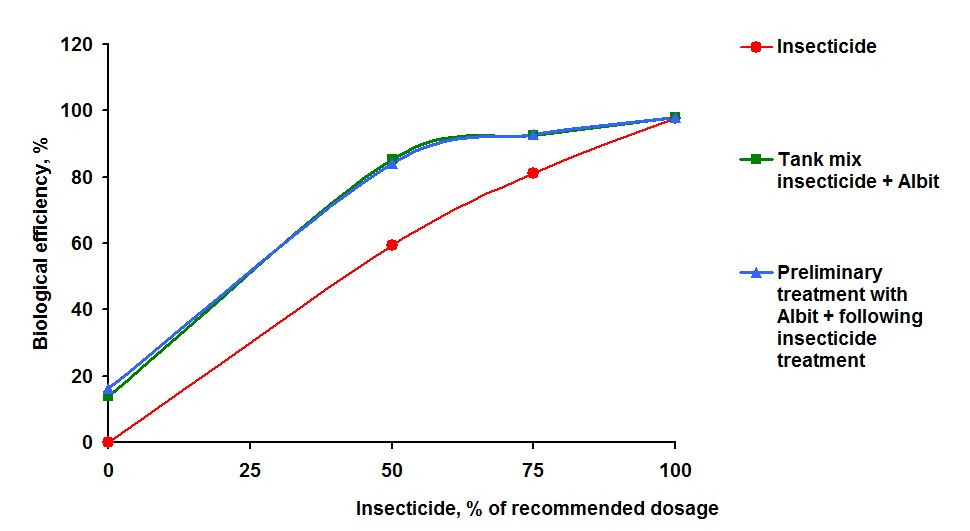
Fig. 1. Biological efficiency of canola plants spraying with insecticide based on deltamethrin and its combinations with Albit against a complex of pests (All-Russia Institute of Biological Plant Protection, 2012)
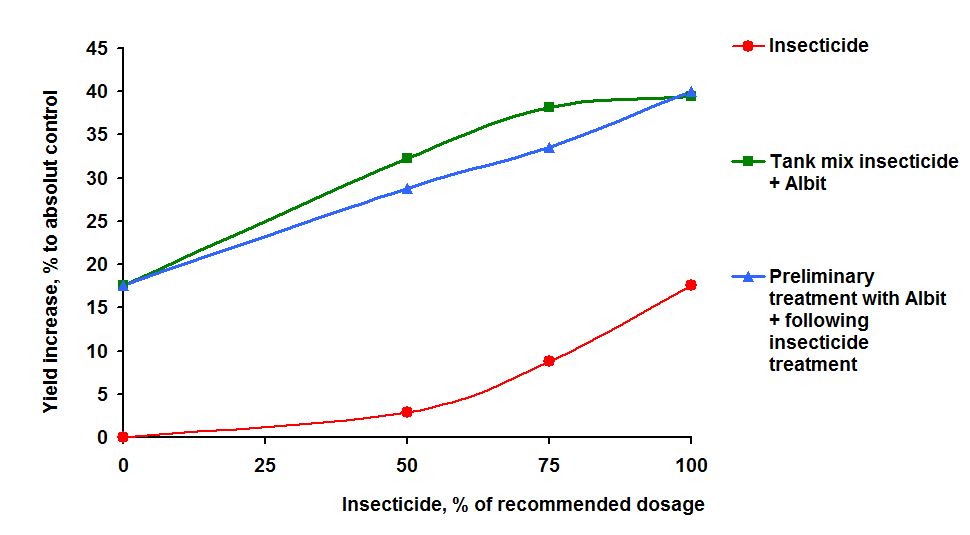
Fig. 2. Effect of insecticide treatment based on deltamethrin and its combinations with Albit on the yield of spring rape (All-Russia Institute of Biological Plant Protection, 2012)
In 2011-2012 Albit and tank mix Albit + insecticide (a.i. deltamethrin) were applied on the winter wheat var. Bat’ko (All-Russia Institute of Biological Plant Protection). Biological effectiveness of preparations against pests, as well as their effect on yield and biochemical parameters of grain were assessed. The number of larvae of wheat thrips (Haplothrips tritici Kurd.) in one spikelet of winter wheat reached 100 pcs. On 3d day after treatment, the average number of thrips larvae in the spike in the control was 105 pcs. The number of thrips larvae in the spike decreased by 19% after treatment with pure Albit (40 mL/ha). The biological effectiveness of insecticide in tank mix with Albit increased by ca. 20% (Fig. 3). At the same time, effectiveness of minimal recommended dosages of insecticide 20-30 g/ha with Albit was almost inferior to maximal dosage of insecticide 40 g/ha.
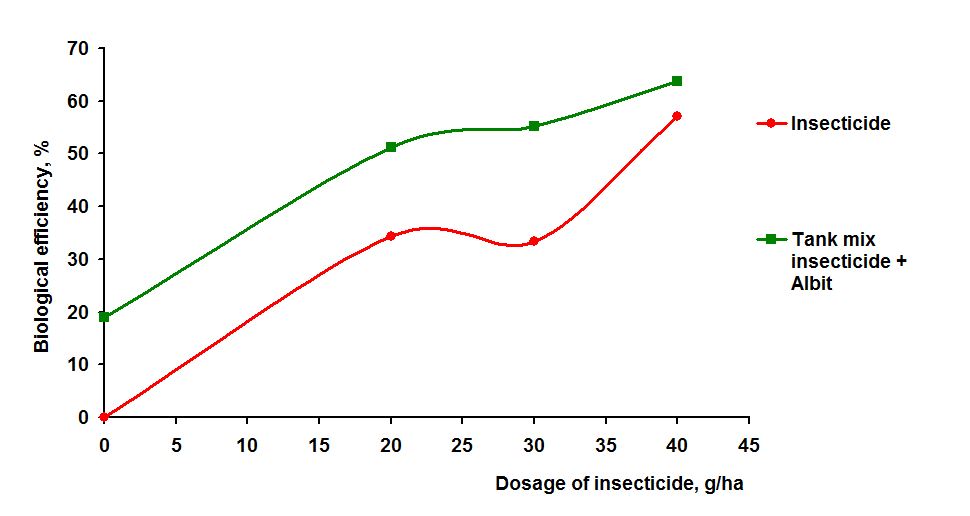
Fig. 3. Biological efficiency of treatments of winter wheat with insecticide and insecticide + Albit against thrips larvae (All-Russia Institute of Biological Plant Protection, 2012)
Adding of Albit to insecticide had positive effect on yield. In variants with insecticide + Albit the yield of winter wheat was by 7.2-7.6% higher than in variant with pure insecticide (Fig. 4). The gluten content in flour in variants with Albit increased by 2-4%, in grain - by 1.4-3%; the content of starch - up to 3.5% and protein - up to 1.0%. In these variants the highest economic effect (pure income) was 1551-2905 rubles/ha.
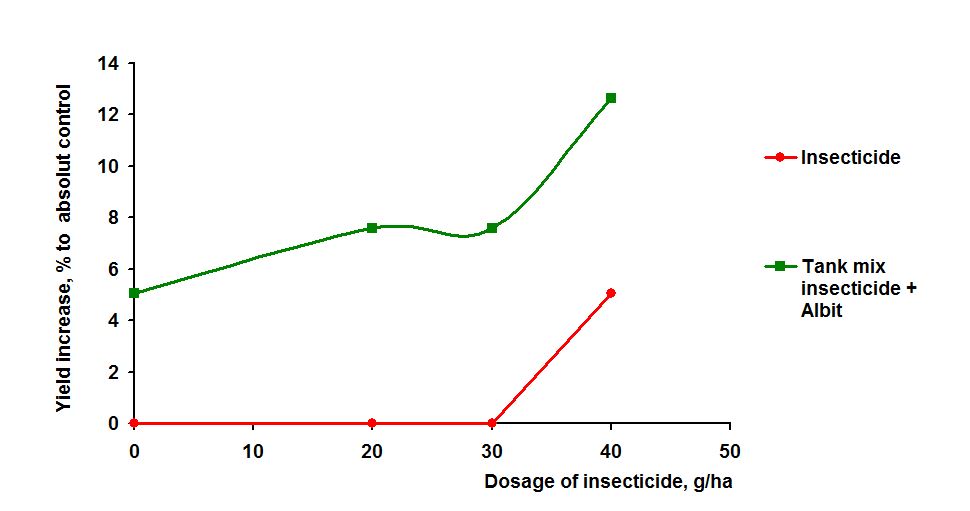
Fig. 4. Influence of treatments with insecticide and insecticide + Albit on the yield of winter wheat (All-Russia Institute of Biological Plant Protection, 2012)
Results of this and also all field trials on joint application of Albit and insecticides are summarized in table 2.
Table 2. Antidote activity of Albit with insecticides in field trials
Nr |
Active ingredient of used insecticide |
Application rate of the |
Application rate of Albit, L/hectare (t) |
Crop |
Yield in var. |
Yield in var. with |
Antidote effect |
Antidote effect, % |
Location of field trial, year |
Comments * |
| 1. | – |
– |
0,035 |
winter canola |
– |
– |
4,0 |
– |
Steiner Rudolf Farm, Switzerland, 2011-2012 |
V |
| 2. | alpha-cypermethrin |
0,15 |
0,05 |
spring canola |
35,3 |
41,3 |
6,0 |
17,0 |
All-Russia Institute of Plant Protection, Voronezh region, 2006 |
V |
| 3. | beta-cypermethrin |
0,3 |
0,05 |
spring canola |
12,5 |
15,6 |
3,1 |
24,8 |
Agricultural Scientific Institute of South-East, Saratov region, 2005 |
V |
| 4. | beta-cypermethrin |
0,3 |
0,03 |
spring canola |
10,2 |
16,7 |
6,5 |
63,7 |
Agricultural Scientific Institute of South-East, Saratov region, 2006 |
V |
| 5. | beta-cypermethrin |
0,3 |
0,05 |
spring canola |
10,2 |
17,8 |
7,6 |
74,5 |
Agricultural Scientific Institute of South-East, Saratov region, 2006 |
V |
| 6. | beta-cypermethrin |
0,3 |
0,07 |
spring canola |
10,2 |
19,7 |
9,5 |
93,1 |
Agricultural Scientific Institute of South-East, Saratov region, 2006 |
V |
| 7. | beta-cypermethrin + dimethoate |
6,0 + 1,2 |
0,04 |
onion |
170,0 |
200,0 |
30,0 |
17,6 |
Collective farm |
V |
| 8. | deltamethrin |
0,02 |
0,04 |
winter wheat |
39,5 |
42,5 |
3,0 |
7,6 |
All-Russia Institute of Biological Plant Protection, Krasnodar krai, 2011-2012 |
V |
| 9. | deltamethrin |
0,03 |
0,04 |
winter wheat |
39,5 |
42,5 |
3,0 |
7,6 |
All-Russia Institute of Biological Plant Protection, Krasnodar krai, 2011-2012 |
V |
| 10. | deltamethrin |
0,04 |
0,04 |
winter wheat |
41,5 |
44,5 |
3,0 |
7,2 |
All-Russia Institute of Biological Plant Protection, Krasnodar krai, 2011-2012 |
V |
| 11. | deltamethrin |
0,015 |
0,06 |
spring canola |
17,5 |
22,5 |
5,0 |
28,6 |
All-Russia Institute of Biological Plant Protection, Krasnodar krai, 2012 |
V |
| 12. | deltamethrin |
0,0225 |
0,06 |
spring canola |
18,5 |
23,5 |
5,0 |
27,0 |
All-Russia Institute of Biological Plant Protection, Krasnodar krai, 2012 |
V |
| 13. | deltamethrin |
0,03 |
0,06 |
spring canola |
20,0 |
23,7 |
3,7 |
18,5 |
All-Russia Institute of Biological Plant Protection, Krasnodar krai, 2012 |
V |
| 14. | deltamethrin |
0,3 |
0,03 |
winter canola |
13,0 |
15,5 |
2,5 |
19,2 |
All-Russia Institute of Biological Plant Protection, Krasnodar krai, 2005-2006 |
V |
| 15. | deltamethrin |
0,3 |
0,04 |
winter canola |
13,0 |
16,0 |
3,0 |
23,1 |
All-Russia Institute of Biological Plant Protection, Krasnodar krai, 2005-2006 |
V |
| 16. | deltamethrin |
0,3 |
0,06 |
winter canola |
13,0 |
18,0 |
5,0 |
38,5 |
All-Russia Institute of Biological Plant Protection, Krasnodar krai, 2005-2006 |
V |
| 17. | deltamethrin |
0,3 |
0,06 |
winter canola |
11,3 |
13,5 |
2,2 |
19,5 |
All-Russia Institute of Biological Plant Protection, Krasnodar krai, 2006-2007 |
V |
| 18. | Imidacloprid + tebuconazole |
2,0 |
0,04 |
winter wheat |
80,40 |
85,50 |
5,1 |
6,3 |
Agricultural Research and Development Station Secuicni-Neamt, Румыния, 2015-2016 |
P |
| 19. | carbofuran |
20 |
0,1 |
sugar beet |
217,8 |
265,5 |
47,7 |
21,9 |
All-Russia Institute of Plant Protection Voronezh region, 2005 |
P |
| 20. | carbofuran |
20 |
0,1 |
sugar beet |
217,8 |
255,0 |
37,2 |
17,1 |
All-Russia Institute of Plant Protection Voronezh region, 2005 |
P |
| 21. | carbofuran |
20 |
0,03 |
sugar beet |
337,3 |
378,8 |
41,5 |
12,3 |
All-Russia Institute of Plant Protection Voronezh region, 2004 |
P |
| 22. | carbofuran |
20 |
0,05 |
sugar beet |
337,3 |
501,3 |
164,0 |
48,6 |
All-Russia Institute of Plant Protection Voronezh region, 2004 |
P |
| 23. | carbofuran |
20 |
0,1 |
sugar beet |
337,3 |
880 |
542,7 |
160,9 |
All-Russia Institute of Plant Protection Voronezh region, 2004 |
P |
| 24. | carbofuran |
20 |
0,03 |
sugar beet |
311,3 |
369,0 |
57,7 |
18,5 |
All-Russia Institute of Plant Protection Voronezh region, 2003 |
P |
| 25. | lambda-cyhalothrin |
0,2 |
0,04 |
winter wheat |
35,2 |
42,3 |
7,1 |
20,2 |
All-Russia Institute of Biological Plant Protection, Krasnodar krai, 2006-2007 |
V |
| 26. | lambda-cyhalothrin |
0,15 |
0,04 |
winter wheat |
54,2 |
54,9 |
0,7 |
1,3 |
Krasnodar Regional Plant Protection Station / Agrofarm “Agrokomplex”, 2006-2007 |
V |
| 27. | lambda-cyhalothrin |
0,15 |
0,04 |
winter wheat |
45,0 |
47,8 |
2,8 |
6,2 |
Krasnodar Regional Plant Protection Station / Agrofarm “Agrokomplex”, 2005-2006 |
V |
| 28. | lambda-cyhalothrin |
– |
0,04 |
winter wheat |
– |
Application of Albit decreased total yield losses caused by diseases and pests from 52% to 18% |
– |
71,0 |
Pushkinskoye experimental farm, |
V |
| 29. | lambda-cyhalothrin |
– |
0,04 |
winter wheat |
– |
Application of Albit decreased total yield losses caused by diseases and pests from 54 % to 17 % |
– |
80,0 |
Pushkinskoye experimental farm, |
V |
| 30. | lambda-cyhalothrin |
– |
0,04 |
spring barley |
– |
Application of Albit decreased total yield losses caused by diseases and pests from 43 % to 12 % |
– |
54,0 |
Pushkinskoye experimental farm, |
V |
| 31. | lambda-cyhalothrin |
– |
0,04 |
spring barley |
– |
Application of Albit decreased total yield losses caused by diseases and pests from 56 % to 23 % |
– |
75,0 |
Pushkinskoye experimental farm, |
V |
| 32. | malathion |
1,2 |
0,05 |
white cabbage |
280,0 |
320,0 |
40,0 |
14,3 |
Vladimir Regional Plant Protection Station, 2006 |
V |
| 33. | malathion |
– |
0,05 |
white cabbage |
300,0 |
350,0 |
50,0 |
16,7 |
Vladimir Regional Plant Protection Station, 2004 |
V |
| 34. | thiamethoxam |
– |
0,04 |
peanut |
35,48 |
37,83 |
2,4 |
6,6 |
Sunbelt Ag Exposition, Georgia, USA, 2013 |
P |
| 35. | thiamethoxam |
0,2 |
0,05 |
potato |
103,5 |
110,9 |
7,4 |
7,1 |
All-Russia Institute of Plant Protection Voronezh region, 2004 |
P |
| 36. | thiamethoxam |
– |
0,04 |
sunflower |
18,4 |
22,1 |
3,7 |
20,1 |
Slovak University of Agriculture in Nitra, Slovakia, 2013 |
P |
| 37. | thiamethoxam |
– |
0,3 |
sunflower |
29,4 |
31,5 |
2,1 |
7,1 |
Slovak University of Agriculture in Nitra, Slovakia, 2014 |
P |
| 38. | thiamethoxam |
– |
0,04 + 0,05 |
soybean |
19,7 |
25,8 |
6,1 |
31,0 |
Sunbelt Ag Exposition, Georgia, USA, 2013 |
P |
| 39. | thiamethoxam + difenoconazole + fludioxonil |
1,8 |
0,1 |
rice |
56,2 |
60,8 |
4,6 |
8,2 |
All-Russia Institute of Rice, Krasnodar krai, 2015 |
P |
| 40. | thiamethoxam + difenoconazole + fludioxonil |
0,9 |
0,1 |
rice |
56,2 |
61,7 |
5,5 |
9,8 |
All-Russia Institute of Rice, Krasnodar krai, 2015 |
P |
| 41. | fipronil |
0,02 |
0,05 |
potato |
362,0 |
406,0 |
44,0 |
12,2 |
All-Russia Institute of Plant Protection Voronezh region, 2003 |
V |
| 42. | cypermethrin |
0,2 |
0,04 |
winter wheat |
55,0 |
55,9 |
0,9 |
1,6 |
Krasnodar Regional Plant Protection Station / Agrofarm “Agrokomplex”, 2006-2007 |
V |
| 43. | cypermethrin |
– |
0,06 |
spring canola |
25,0 |
30,0 |
5,0 |
20,0 |
z/s Vaiculevas, Latvia, 2010 |
V |
* – insecticidal seed treatment agent
Thus, based on field trial data of many years, it can be concluded that Albit boosts the level of resistance of cereals, legumes, potato, vegetable and other crops towards insect pests by ca. 20%. By the same degree, biological efficacy of insecticides increases.
In the variants with tank mixes of insecticide + Albit yield increases by 29.4% than in variant with pure insecticide (the average value of antidote effect for all field trials, please, see in Table 2).
Albit is officially patented as a product for reducing the phytotoxic effect of insecticides on crops [5].
LIST OF REFERENCES
- Xiao J.X., Huanga Y.Y., Wanga L., et al. Pesticides-induced depression of photosynthesis was alleviated by 24-epibrassinolide pretreatment in Cucumis sativus L. // Pesticide Biochemistry and Physiology. – 2006. – V. 86 (1). – P. 42-48.
- Catalog of preparations 2015. Plant Protection Products. MTS “Agro-Alliance”. 2015. p. 80-81 (in Russian)
- Guide of agrarian. Special issue of newspaper “Land and Life of the SFD”. 2016. p. 31-32 (in Russian)
- Zlotnikov A.K. Assessment of Albit efficiency in the system of field crops protection against insects / A.K. Zlotnikov, A.T. Podvarko, T.A. Ryabchinskaya, N.A. Kudryavtsev, K.M. Zlotnikov, I.M. Khanieva // Zemledelie (Agriculture). – 2017. – № 4. – P. 37-42. (In Russian)
- Zlotnikov A.K. Efficiency of Albit in combined use with insecticides on canola / A.K. Zlotnikov, V.R. Sergeev, I.I. Begunov, V.B. Lebedev // Zashchita i Karantin Rastenij (Plant Protection and Quarantine). – 2007. – № 8. – P.40. (In Russian)
- Zlotnikov А.К. Patented invention No. 2518252 “Antidote composition of biological origin for use in crop production”/ А.К. Zlotnikov, K.M. Zlotnikov, I.К. Zlotnikovа, S.А. Pavulsone // Priority dated 03.12.2012., issued 08.04.2014 (in Russian)
| NOTICE: | Information contained on this page is provided according
to the Terms and Conditions located at
www.albit.com/application/disclaimer.php
|