 |
An innovative plant growth promoter for organic and traditional farming
|
 
|
Spring wheat |
|


Materials used in this chapter were published in the book: Biostimulant Albit for increasing yields and protection of agricultures against diseases, A.K. Zlotnikov, Ed. Prof. А. Melkumova. All-Russia Institute of Plant Protection, Russia, 2006.г.
 Influence
of Albit on spring wheat was examined in more than 45 field trials in many
regions of Russia (Altay, Republics of Buryatia and Tuva, Primorye krais, Bryansk,
Kemerovo and others). Trials were performed since 1997 year on the following
varieties of wheat: Altayskaya-50, Selenga, Primorskaya-39, Omskaya-20,
Novosibirskaya 89, Omskaya-18, Vera, Irgina, Prokhorovka, Saratovskaya 60,
Voronezhskaya-6, Kurskaya-2038, L-503, Saratovskaya 42, Saratovskaya 55,
Saratovskaya 58, L-505, Kantegirskaya, Priokskaya, Voronezhskaya-10, Iren and
others in Far East Institute of Plant Protection, Kurgan Institute of Grain
Growing, Agricultural Scientific Institute of South-East, Soil Institute, Central
Institute of Agrochemical Service (Pryanishnikov All-Russia Institute of Agrochemistry),
Aleysk Station of Agrochemical Service, Buryatia, Kemerovo, Kurgan, Kursk,
Lipetsk, Penza, Primorye, Saratov, Tuva Regional Plant Protection Stations,
Karachaevo Plant Protection Station of Bryansk oblast, Ryazan State Agricultural
Academy and others.
Influence
of Albit on spring wheat was examined in more than 45 field trials in many
regions of Russia (Altay, Republics of Buryatia and Tuva, Primorye krais, Bryansk,
Kemerovo and others). Trials were performed since 1997 year on the following
varieties of wheat: Altayskaya-50, Selenga, Primorskaya-39, Omskaya-20,
Novosibirskaya 89, Omskaya-18, Vera, Irgina, Prokhorovka, Saratovskaya 60,
Voronezhskaya-6, Kurskaya-2038, L-503, Saratovskaya 42, Saratovskaya 55,
Saratovskaya 58, L-505, Kantegirskaya, Priokskaya, Voronezhskaya-10, Iren and
others in Far East Institute of Plant Protection, Kurgan Institute of Grain
Growing, Agricultural Scientific Institute of South-East, Soil Institute, Central
Institute of Agrochemical Service (Pryanishnikov All-Russia Institute of Agrochemistry),
Aleysk Station of Agrochemical Service, Buryatia, Kemerovo, Kurgan, Kursk,
Lipetsk, Penza, Primorye, Saratov, Tuva Regional Plant Protection Stations,
Karachaevo Plant Protection Station of Bryansk oblast, Ryazan State Agricultural
Academy and others.
Averagely, according to results of all performed trials, treatment with Albit increased the yield of spring wheat by 2.9 centners/hectare (16.4%). Average extra yield due to Albit was 2.1 centners/hectare in Altay krai, by 1.2 centners/hectare in Buryatia, 3.6 centners/hectare in Kemerovo oblast, 4.4 centners/hectare in Kursk oblast, 3.8 centners/hectare in Lipetsk oblast, 2.9 centners/hectare in Penza, Saratov oblasts and in Primorye krai, 3.3 centners/hectare in Ryazan oblast, 0.4 centners/hectare in Tuva. Albit provides considerable relative yield increase in cases of both high and low original productivity levels.
 |
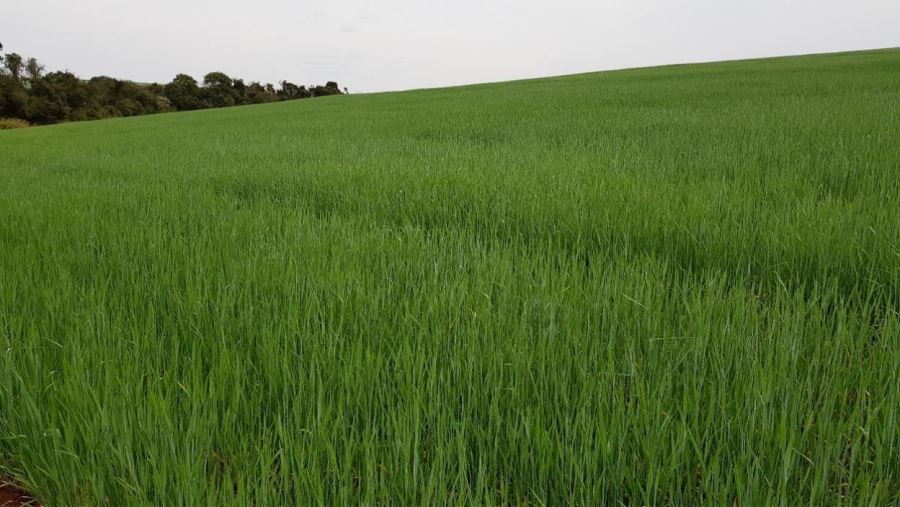 |
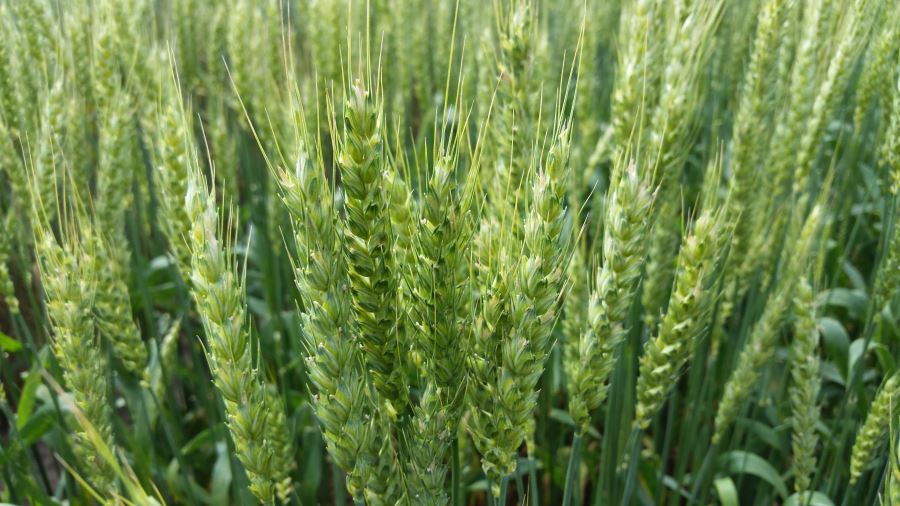
Spring wheat grown with Albit application.
Top - Vladimir oblast, 2016.
Bottom - Fazenda Santa Maria, Parana, Brazil, 2018. Yield increase of spring wheat due to Albit was 7.4 centners/hectare (30%)
Albit demonstrated high Biological Efficiency (BE) against the following diseases of spring wheat: 81.7% against powdery mildew, 59.2% against root rots, 51.2% against Septoria leaf spot, 50% against kernel black point, 46.4% against brown rust, 79.0% against stinking smut, 48.5% against loose smut, 46.4% against Helminthosporium rot, 43.4 against Fusarium head scab, 40.4% against Fusarium wilt. Fungicidal activity of Albit is detected at the disease prevalence (P) level of 2-100% and disease development (R) of 1-60%. Albit is officially registered in Russia as a fungicide against root rots, brown rust, septorioses and powdery mildew of spring wheat.
On spring wheat Albit is applied as antidote for reducing of phytotoxic effect of pesticides. Also Albit increases germination, activates growth and development, increases drought resistance and resistance to other unfavorable climate conditions, increases yield, improves yield quality (increase of gluten content).
Besides yield increase and disease control, Albit increases germination ability, accelerates germination and changes of phenological stages, increases productive stem density, total and productive tillering, ear length, number of seeds in ear and weight of seeds, total protein and gluten content in grain (on average by 1.6 absolute %, 2.3 % to control) (Table 1), improves rootage (lenght of roots and formation of secondary roots ) and drought resistance. Ability of Albit to increase drought resistance, and to accelerate maturing of wheat is especially important and was most clearly visible in regions of continental climate, such as Kurgan oblast (1997, 1998, 2000, 2001), Buryatia (2003), Tuva (2001), Krasnoyarsk kraj (2007, 2009, 2017). According to long-term field trials in ОАО «Kоrkinоаgrоprоmkhimiya» in Krasnoyarsk kraj (since 2007), spring wheat after Albit treatment become more early-ripe, annually maturing by 1-2 weeks earlier. It allows to harvest before autumn rains (or even before snow). For example, 1 fold Albit application allowed to start harvest by 5 days early, than on fields without Albit treatment (farm Cheremushka, Balahtinskii region, 2009). 2 fold Albit application (with herbicide and fungicidal treatments) allowed to grow spring wheat (crop yield 3.1 t/hа) with a high baking parameters (26-28% of gluten) and start harvest on August 14 – by 12 days early than in other farms of this climatic zone (farm Plemzavod Taezhnii, Suhobuzimskii region). In 2017, early snow was observed, and Albit application allowed to harvest in all farms of this region where Albit was applied.
Table 1. Influence of Albit application on gluten content in spring wheat (selected data)
Variety of spring wheat |
Gluten content in control, % |
Increment of gluten content, abs. % |
Field trial, location, year |
Arnaut-7 |
20,6 |
3,0 |
Institute of Genetics, Physiology and Plant Protection, Kishinev, Moldavia, 2011 |
Alejskaya 30 |
25,3 |
3,0 |
FGUSАS "Alejskaya", Altaj kraj, 2004 |
Al'bidum 188 |
27,2 |
3,6 |
ZАО "Mayak", Orenburg oblast, 2005 |
Vera |
23,4 |
2,9 |
Kurgan Scientific Institute of Grain Crops, 1997-1998 |
Kinel'skaya 59 |
29,4 |
2,5–3,4 |
Samara State Agricultural Academy, 2004-2006 |
Kurskaya 2038 |
20,0 |
2,1 |
V. V. Dokuchaev Soil Science Institute, Kursk oblast, 2002 |
Omskaya 18 |
30,4 |
5,2 |
Kurgan Scientific Institute of Grain Crops (CsINAO), 2001 |
Priokskaya |
26,1 |
2,0 |
ОPH "Alyoshinskoe", Ryazan' oblast, 1997-1998 |
Application recommendations. Recommended full treatment of spring wheat with Albit includes presowing seed treatment (application rate of working solution 10 L/t) and double foliar spraying (BBCH 20–40 and BBCH 50–70). The second foliar treatment may be also conducted at the booting stage – stage of flag leaf (in this case, decrease of gluten content may occur despite of yield increase). For spring wheat of northern regions and if vegetating season is wet, 2nd spraying should be abolished. Аpplication rate of working solution: 200–300 L/ha (ground sprayers), 50–100 L/ha (aviation sprayers). It is reasonable to apply Albit together with fungicides (full or halved dose) during the presowing seed treatment and with herbicides, liquid fertilizers or insecticides during spray treatments. Seed treatment with Albit in case of presence of smut or other internal diseases must be performed jointly with chemical fungicide treatment. Recommended application rates of Albit are: 40–100 mL/t, 30–40 mL/ha. The higher rate of Albit (100 mL/t for seed treatment or 40 mL/ha for foliar spraying) is used for control of phytotoxic effect of protectants and prolonged immunization of plants during vegetation season. Presowing seed treatment is most important kind of treatment; it makes up 50–60% of total effect of Albit. First foliar spraying is also highly efficient (BBCH 20–40). The second foliar spraying is just a useful addition to first two treatments and aimed mainly on improvement of yield quality. In northern regions of Russia, and also in cold and humid years, treatments in second half of vegetation are not recommended.
Since application of herbicides causes stress and intoxication of spring wheat, they should be used in combination with an antidote (Albit). Results of trials performed in different regions of Russia demonstrate that Albit used in mixes with herbicides can effectively relieve herbicidal stress of spring wheat, while effectiveness of herbicides remains intact. Combination of Albit with insecticides is also quite effective. For example, application of Albit together with insecticide based on lambda-cyhalothrin on spring wheat in Pushkinskoye Experimental Farm (Nizhniy Novgorod oblast) decreased diseases- and pests-caused yield losses averagely by 30% comparing to control treated with pure insecticides (Table 1).
In the conducted field trials economical or biological effectiveness of Albit was not inferior to that of of formulations based on Pseudomonas aureofaciens and its metabolites, biologically active compounds from cedar and fir, orthocresoxiacetates, Bacillus subtilis, tebuconazole, Trichoderma viridae, thiabendazole, flutriafol, cyproconazole, dihydroquercetin, triterpene acids, humates and other analogues.
In the following Table, you can see all reports on performance of Albit on spring wheat, available in English. For all available reports, please see corresponding table on Russian webpage.
№ |
Year |
Country |
Region |
Institute / Farm |
Report |
| 1 | 2015 |
Latvia |
Stende |
State Institute of Breeding of Field Crops |
 |
| 2 | 2014 |
Latvia |
|
Latvian University of Agriculture / Vecauce farm |
|
| 3 | 2006-2008 |
Russia |
Mordovia | Mordovia State University / ‘Constantine’ Ltd. |
|
| 4 | 2004-2006 |
Russia |
Samara region |
Samara State Agricultural Academy |
|
| NOTICE: | Information contained on this page is provided according
to the Terms and Conditions located at
www.albit.com/application/disclaimer.php
|