 |
An innovative plant growth promoter for organic and traditional farming
|
 
|
Influence of Albit on yield quality |
|


Materials used in this chapter are published in book 'Biostimulant Albit for increasing yields and protection of agricultures against diseases', A.K. Zlotnikov, Ed. Prof. А. Melkumova. All-Russia Institute of Plant Protection, Russia, 2006.
The product quality is a very important parameter in highly profitable crop production. For example, yield of wheat, rape, vegetables and potato should have a high parameters, such as: gluten content, oil content, marketability and biochemical parameters, respectively.
Albit, product of biological origin, is widely known to farmers in our country and abroad. Albit positively influences on crop quality due to antidote (reducing the pesticidal stress, which prevents the formation of quality products) and growth-regulating actions. This fact is based on data of long-term trials.
In Russia, Albit is officially registered as growth regulator, which improves yield quality of wheat (gluten content), barley, triticale, rye, rice, oats (reduces the content of mycotoxins), maize, buckwheat, millet, sorghum, sunflower, soybeans, flax, legumes, sugar beets (increases the sugar content of root crops), table beets, potato (increases the yield of commercial tubers), rapeseed (increases the oil content in seeds), lettuce and vegetable crops (increases the content of vitamins in fruits, decreases the nitrate content), perennial grass, vine (increases plumpness and weight of cluster, the number of ripe fruits in cluster), horticulture and berry crops (in Russia, certificate of State registration № 081-07-866-1 dated November 26, 2015).
According to results of 500 field trials, Albit increases gluten content in wheat on average by 1.6 abs.%, sugar content in sugar beet on average by 0.3-2.5 abs. %, oil content in rape by 0.2-3.6 abs. %. After Albit treatment, fraction of commercial yield of potato tubers increases up to 34% over control. Fraction of commercial yield of grapevine increases by 10-25%, organoleptic characteristics and flavour of grapes are improved, losses of flavouring and aroma are decreased by 75% during storage, residual amount of pesticides decreases on average by 50%. In vegetables vitamin content increases by 6-25%, nitrate content decreases by 16-26%. In field trial, conducted in experimental station ACPEL (France), among all tested plant growth regulators and fungicides, only Albit increased fraction of commercial yield of melons. Also, Albit reduces of mycotoxin content in grain crops by 20-70%.
Currently, one of the main problems of cereal farming is protein content in grain. This parameter directly determines the cost of grain. Treatments with pesticides can cause stress and inhibition of plant growth. Finally, pesticide applications may cause the reducing of gluten content. As a result, farmers have a high yield with poor quality. Foliar spraying with liquid nitrogen fertilizers (it is quite expensive) or anti-stress products may resolve this problem. Application of Albit as anti-stress product in combination with chemical pesticides for improving the yield quality of cereal crops is a well approved effective agricultural method.
Presowing treatment of wheat with Albit has a greater effect on yield than on crop quality. For increasing the gluten content, foliar spraying is necessary. This fact was established in trials with Albit application. For example, in Kursk region of 2001–2003, presowing seed treatment of winter wheat with Albit increased gluten content average by 0.8%; foliar spraying at the tillering stage – by 3.8%, on spring wheat by 1.4 and 2.1%, respectively. In the southern regions of Russia (Rostov oblast, Krasnodar krai), the second foliar spraying with Albit at the booting–earing stages significantly increased gluten content by 1.5%. Combined application of Albit with liquid urea effectively improves yield quality. Application of Albit on spring wheat increased the protein content by 0.5%, Albit with urea – by 0.8% (data of Department of Agricultural Chemistry, Moscow State University). Probably, the high efficiency of their combined application is explained as follows: a high consumption rates of urea (up to 30 kg/ha or 10% solution) are used in production conditions for foliar spraying of cereals, whereas already 1% solution is toxic for plants. Albit reduces the toxic effect of urea, while the additional nitrogen of urea is fully used for accumulation of protein in grain.
It is known that gluten content in the grain decreases as a result of root rot infestation. Therefore, a high biological efficiency of Albit against these diseases (57–100%) contributes to increasing of crop quality.
There are many examples of successful Albit application for increasing the gluten content in the crop (Tables 1, 2). For example, in the farm Zarya and farm of A.V. Tutov in Rostov region, Albit had been applied annually on winter wheat from 1999 to 2004 for presowing seed treatment and spraying according to recommendations. The average yield of 1999–2002 was 4.5–4.9 t/ha, gluten content 26–29%, parameter “gluten deformation measurement” – 65–95. Neighboring farms that did not use Albit, received mainly fodder grain. The same result was obtained in farms of Tatarstan Republic. In trials of Kursk region on winter wheat (2002), the gluten content in variant with Albit was 30.4% (by 4.8% higher than in control), parameter “extensibility of gluten” increased from 13 to 14 cm. In Kurgan region (Kurgan Institute of Grain Growing, 1997) in variant with Albit, gluten content of spring wheat increased from 23.4% to 26.3%, in 2001 yield increase was 5.1%. In Ryazan' region (farm Aleshinskoe, Rybnovsky district, 1998), protein content in wheat after Albit application increased from 13.8 to 15.2%, gluten content from 26.1 to 28.1%.
Table 1. Influence of Albit application on gluten content in winter wheat (selected data)
Variety of winter wheat |
Gluten content in control, % |
Increment of gluten content, abs. % |
Field trial, location, year |
Kolompos |
32,7 |
2,3 |
Agricultural Research Institute, Martonvasar, Hungary, 2013-2014 |
Bat'ko |
22,0 |
2,6 |
All-Russia Institute of Biological Plant Protection, Krasnodar kraj, 2006-2007 |
Bat'ko |
34,0 |
2,6 |
All-Russia Institute of Biological Plant Protection, Krasnodar kraj, 2010-2011 |
Bat'ko |
34,0 |
2,6 |
All-Russia Institute of Biological Plant Protection, Krasnodar kraj, 2011-2012 |
Bat'ko |
20,8 |
2,3 |
ZAO АF "Agrokompleks", Krasnodar kraj, 2007-2008 |
Bat'ko |
17,1 |
5,3 |
ZAO АF "Niva", Krasnodar kraj, 2003-2004 |
Bezenchukskaya 380 |
25,0 |
2,2 |
ZAO "Zemlyanskoe", Voronezh oblast, 2006-2009 |
Dar Zernograda |
28,8 |
2,2 |
Stavropol' Research Institute of Agriculture, 2007 |
Kaly'm |
26,5 |
1,2–4,5 |
All-Russia Institute of Biological Plant Protection, Krasnodar kraj, 2012-2013 |
Moskvich |
24,8 |
2,0 |
ОАО "Avtoban-Аgro", Krasnodar kraj, 2010 |
Moskovskaya 39 |
25,6 |
4,8 |
V. V. Dokuchaev Soil Science Institute, Kursk oblast, 2002 |
Odesskaya 267 |
25,5 |
2,5 |
Scientific Institute of Agriculture, Belgorod, 2006 |
Pamyat' |
17,1 |
2,1 |
СPK "Nasha Rodina", Krasnodar kraj, 2006-2007 |
Prikumskaya 152 |
21,0–22,5 |
1,0–3,4 |
Prikumskaya ОSS, Stavropol' kraj, 2004-2005 |
Umanka |
19,2 |
3,4 |
СPK "Praskoveya", Stavropol' kraj, 2004 |
Table 2. Influence of Albit application on gluten content in spring wheat (selected data)
Variety of spring wheat |
Gluten content in control, % |
Increment of gluten content, abs. % |
Field trial, location, year |
Arnaut-7 |
20,6 |
3,0 |
Institute of Genetics, Physiology and Plant Protection, Kishinev, Moldavia, 2011 |
Alejskaya 30 |
25,3 |
3,0 |
FGUSАS "Alejskaya", Altaj kraj, 2004 |
Al'bidum 188 |
27,2 |
3,6 |
ZАО "Mayak", Orenburg oblast, 2005 |
Vera |
23,4 |
2,9 |
Kurgan Scientific Institute of Grain Crops, 1997-1998 |
Kinel'skaya 59 |
29,4 |
2,5–3,4 |
Samara State Agricultural Academy, 2004-2006 |
Kurskaya 2038 |
20,0 |
2,1 |
V. V. Dokuchaev Soil Science Institute, Kursk oblast, 2002 |
Omskaya 18 |
30,4 |
5,2 |
Kurgan Scientific Institute of Grain Crops (CsINAO), 2001 |
Priokskaya |
26,1 |
2,0 |
ОPH "Alyoshinskoe", Ryazan' oblast, 1997-1998 |
Application of Albit on brewer's barley often raises the question about possible effect of Albit on protein content in crop (similar to wheat). Recommended 2 fold Albit application (presowing seed treatment and spraying at the tillering stage) does not increase the protein content in crop, however, 3 fold treatment (seed treatment + spraying at the tillering stage + spraying at the earing stage) in spite of higher yield (yield increase was 12.1%) increases protein content over permissible level. That is, the second spraying with Albit of brewer's barley is undesirable (data of All-Russia Institute of Plant Protection).
Albit reduces the content of mycotoxins (ochratoxins, DON, T-2, NT-2) by 25-100% to control in oats, wheat, and barley according to data of field trials. Protection of cereal crops against contamination by mycotoxins with using of traditional fungicides of direct action is not always effective, since toxins produce not only phytopathogenic, but also saprophytic, endophytic, mold fungi. Moreover, application of chemical fungicides may lead to increasing of ochratoxin content in barley seeds and NT-2 toxin in wheat seeds according to our data. Perhaps, it happens due to suppression of atoxinogenic microflora. Application of fungicides-immunizers is a perspective resolution of this problem. Immunizing effect of Albit allows you to control the development of pathogens that do not give visible symptoms of disease, for example, toxinogenic fungi in the ear. Albit has a biological effectiveness against fusariose of ear 35–45%, and Alternaria – up to 50%.
Also, Albit influences on crop quality of non-cereal crops (data of field trials). For example, marketability of potato tubers under Albit treatment increased on average by 6.9% (data of All-Russia Institute of Plant Protection, 2003). After Albit application on early variety Sante, the total potato yield increased by 11.8%, while the yield of healthy marketable tubers increased by 23% (All-Russian Research Institute of Potato Farming by A.G. Lorh, Moscow oblast, Fig. 1).
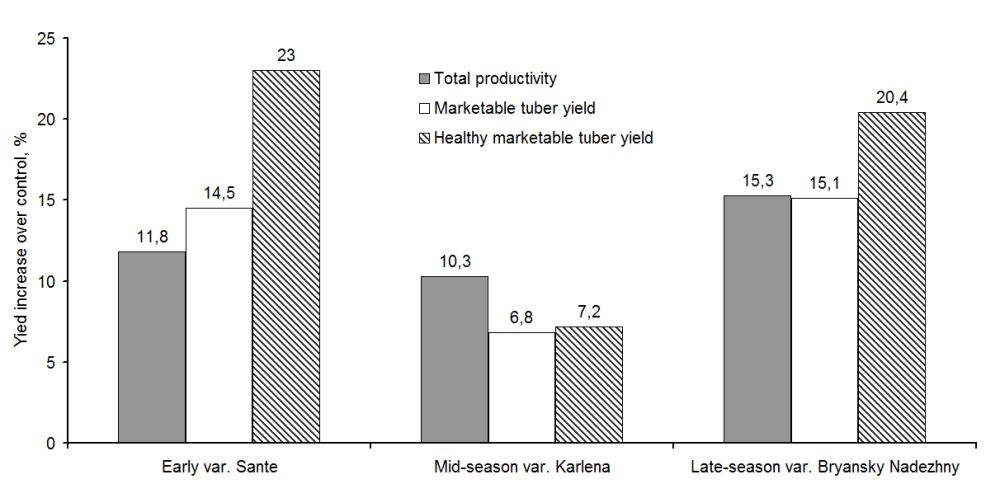
Fig. 1. The effect of Albit on total yield and marketable yield of different potato varieties in field conditions (All-Russian Research Institute of Potato Farming by A.G. Lorh, Moscow oblast, 2009).
Decreasing the number of rotten tubers, increasing the fraction of large tubers (>50 g) were detected (State Institute of Field Crops Breeding, Latvia, 2013–2014). Marketability of potato tubers var. Gala was increased by 30% under Albit treatment (data of Agroholding Kornev Group, 2015). Increased content of starch in tubers by 12–15% was detected in some varieties of potato (Bashkir State Agrarian University, 2001–2007; State Institute of Field Crops Breeding, Latvia, 2014). In 2015, the Institute of Soil Science and Plant Cultivation in Pulawy (Poland) conducted a trial to study the effect of Albit on potatoes of the Owacja variety. Albit application (40 ml/ha) on potatoes increased total yield of tubers by 14% and yield of commercial fraction by 34% (Fig. 2).
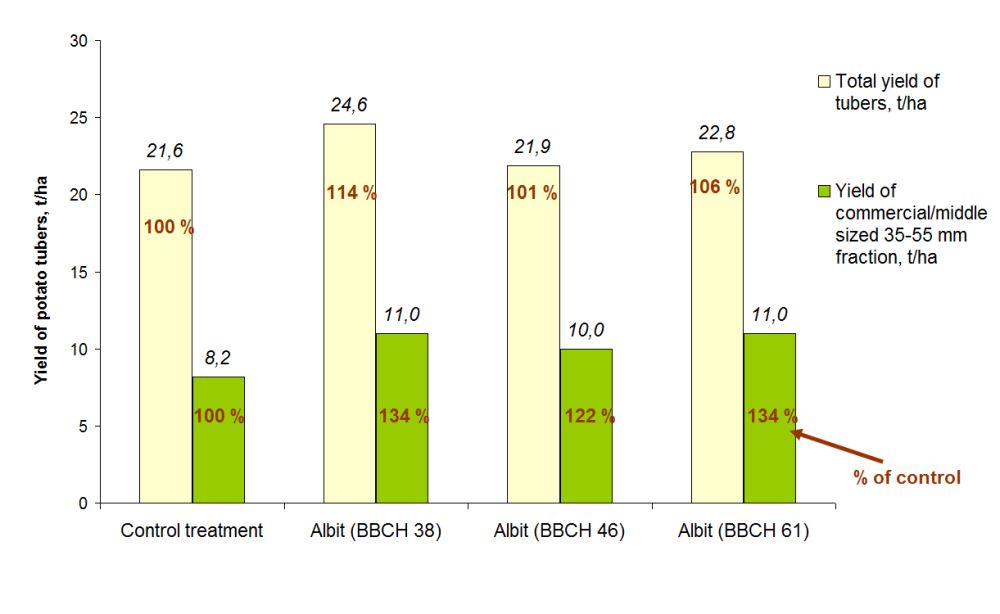
Fig. 2. Effect of Albit spraying at different stages of growth on the yield of potato tubers (Institute of Soil Science and Plant Cultivation, Pulawy, Poland, 2015)
Thereby, Albit increases the yield of medium-sized marketable potato.
According to data of All-Russian Research Institute of Flax (2004), fiber quality of fiber flax was significantly improved under Albit treatment: percentage-number of flax fiber increased by 26.1–55%, number of long fiber – by 0.5–1.3%. Under Albit treatment, sugar content of sugar beet increased on average by 0.3–2.5 abs. % (data of All-Russia Institute of Plant Protection, 2005), oil content of oilseed rape – by 0.4–2.2 abs. % (data of Plant Breeding Institute, Estonia, 2011; Vastankvarn Experimental Farm, Finland, 2011, 2012). At the same time, increasing the oil content in sunflower under Albit treatment was not observed, but total oil yield per hectare was higher due to yield increase (data of All-Russia Institute of Plant Protection, 2002, 2007).
Increasing the content of vitamins in vegetable and berry crops by 2–25% was observed under Albit treatment (Table 3). Increasing the content of beta-carotene and ascorbic acid was especially noticeable. According to data of All-Russia Institute of Vegetable Selection and Seed Breeding in 2004 and G. Mendel University (Brno, Czech Republic, 2014), Albit treatment of onion in open ground increased vitamin C content by 6.2–40.8% and lettuce – by 6.3–21.9%, respectively. Total antioxidant capacity (TAS) of lettuce leaves increased by 43–257%. Albit increases the content of ascorbic acid and reduces the content of nitrates in leaves of lettuce grown in greenhouses (data of All-Russia Institute of Vegetable Selection and Seed Breeding, 2001–2004). The ratio of ascorbic acid and nitrates is equal to 2: 1, that is, Albit makes vegetables grown in greenhouses safer for eating. The same effect was also observed on Chinese cabbage, tomatoes, cucumbers and onions (data of All-Russia Institute of Vegetable Selection and Seed Breeding, 2001–2004). Under Albit treatment, content of nitrates decreased by 16–26% in vegetable crops, in onion biomass (green) – by 74–77%. The content of dry matter in onion leaves also increased by 7.4–10.7%, increasing the nutritional value of yield.Table 3. Influence of Albit application on content of vitamins in vegetables and berries
Crop |
Quality index |
Yield increase after Albit treatment, % |
Location of field trial, year |
Blueberry (berries) |
Vitamin С |
13,8 |
Farm Keith Smith, Georgia, USA, 2015 |
Potato |
Vitamin С |
2-11 |
Lorkh All-Russia Institute of Potato Growing, Moscow oblast, 2001-2007 |
Onion (leaves) |
Vitamin С |
6,2-40,8 |
All-Russia Institute of Vegetable Selection and Seed Breeding, Moscow oblast, 2004 |
Carrot |
ß-carotin |
16,9-18,2 |
All-Russia Institute of Vegetable Selection and Seed Breeding, Moscow oblast, 2001 |
Bulgarian pepper |
Vitamin С |
5,2 |
All-Russia Institute of Vegetable Selection and Seed Breeding, Moscow oblast, 2005 |
Lettuce (leaves) |
Vitamin С |
6,3-21,9 |
Mendel University in Brno, Czech Republic, 2014 |
Vitamin С |
11-25 |
All-Russia Institute of Vegetable Selection and Seed Breeding, Moscow oblast, 2004 | |
Vitamin С |
15,5-17,7 |
All-Russia Institute of Vegetable Selection and Seed Breeding, Moscow oblast, 2001 |
|
Blach currant (berries) |
Vitamin С |
7,4-13,8 |
All-Russia Institute of Vegetable Selection and Seed Breeding, Moscow oblast, 2001 |
Tomato |
Vitamin С |
14,5 |
All-Russia Institute of Vegetable Selection and Seed Breeding, Moscow oblast, 2001 |
ß-carotin |
21,3-22,4 |
All-Russia Institute of Vegetable Selection and Seed Breeding, Moscow oblast, 2001 |
|
Dog rose (fruit) |
Vitamin С |
5,5 |
All-Russia Institute of Vegetable Selection and Seed Breeding, Moscow oblast, 2004 |
Vitamin С |
5,3-8,8 |
All-Russia Institute of Vegetable Selection and Seed Breeding, Moscow oblast, 2001 |
Under Albit treatment, vitamin C content increases by 5.3–13.8% in fruits of apples, currant, hips; marketable appearance of fruits and berries is improved; the number of rotten and dried berries of black currant and cherry is decreased, berry size is increased by 10–20% (data of All-Russia Institute of Plant Protection, All-Russia Institute of Vegetable Selection and Seed Breeding, 2001–2003); weight of 1 berry of garden strawberry is increased on average by 1.3 g (data of I.V. Michurin Institute of Horticulture, 2002). In field trial of Experimental Station ACPEL (Chatelroux, France, 2014), marketable yield of melons under Albit treatment increased by 6%, while in variants with using some biological and chemical standards, it decreased by 4–25% (Fig. 3). The similar results were obtained under Albit treatment in farm Terkin of Serafimovichsky district (Volgograd region).
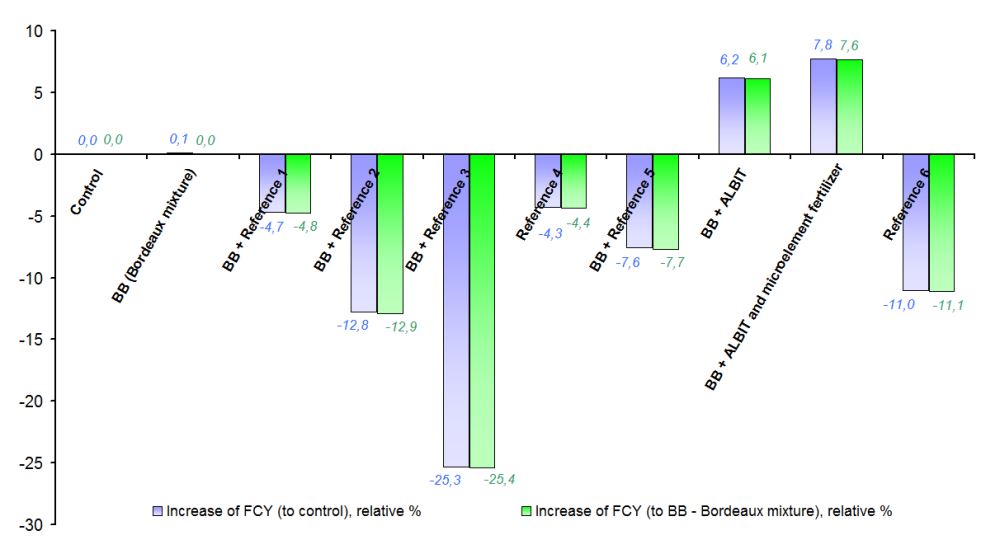
Fig. 3. Influence of Albit and reference products on fraction of commercial yield (FCY) of melon, in field trials (ACPEL experimental center, Chatelroux, France, 2014)
Trials performed by North-Caucasian Institute of Horticulture and Viticulture of Krasnodar krai demonstrated that Albit increases weight and plumpness grape bunch by 21-24%. Field trials of Crimea (National Institute of Grapevine and Wine “Magarach”», Yalta) demonstrated that use of Albit improves the organoleptic properties and gains the variety aromas of berries of table varieties (total organoleptic score is increased by 21.5 %) (Fig. 4). Under Albit treatment, content of main flavonoid compounds in berries of grapevine is increased (flavonols by 5.9%, anthocyanins by 24.4%, stilbenes by 32.8%). The trace amount of pesticides in production is decreased by 51.5%. Albit inhibits sugar and organic acids decay during storage: losses of flavouring and aroma are decreased by 75%, decrease of berries weight was by 39.5% (National Institute of Grapevine and Wine “Magarach”, 2014).
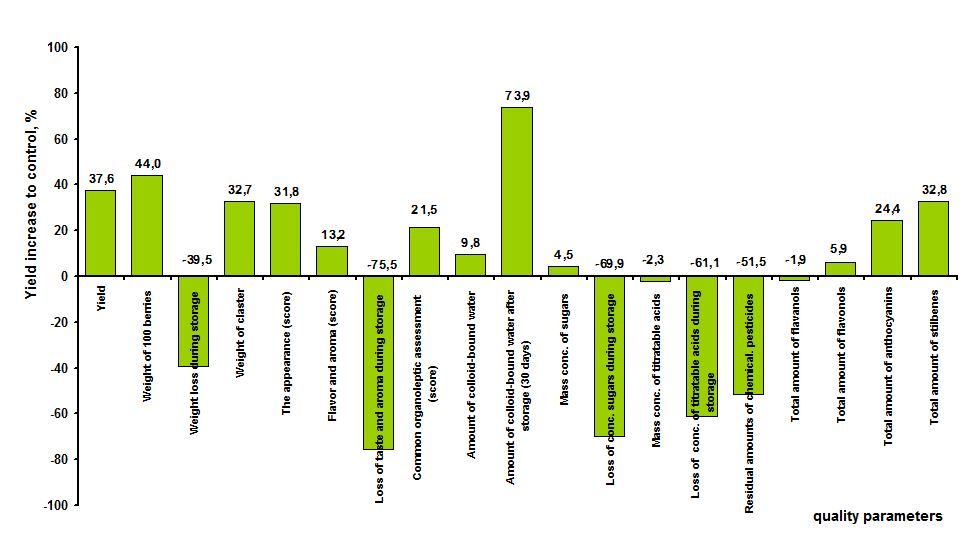
Fig. 4. Influence of Albit on parameters of quality of grapevine yield (average data of all studied table and technical varieties, growing on boghara and in conditions of drip irrigation, "Magarach", Crimea, 2014)
Treatment of flowers (roses, gladioluses, pinks, cyclamens, Kaffir lily, amaryllis, violets, primula etc.) with Albit besides induction blossoming improves decorative appearance, increases the number of flowers per plant, increases production of top-quality flowers (by 10-15%), provides more bright and saturated coloration of flowers and increases resistance to diseases (data of All-Russia Institute of Vegetable Selection and Seed Breeding, 2001–2006).
Thus, long-term trials on a wide range of crops convincingly show that plant growth regulator Albit can be effectively used in farming practice to improve product quality and marketability. For obtaining the desired result, you should strictly adhere to recommendations for application on each crop.
| NOTICE: | Information contained on this page is provided according
to the Terms and Conditions located at
www.albit.com/application/disclaimer.php
|