|
|
|
Untitled Document

|
Gooseberry |
|
Materials used in this chapter were published in the book Biostimulant Albit for
increasing yields and protection of agricultures against diseases, A.K. Zlotnikov,
Ed. Prof. А. Melkumova. All-Russia Institute of Plant Protection, Russia, 2006.
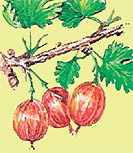 Gooseberry (Grossularia reclinata Mill, order Saxifragaceae) is
valuable berry culture. Gooseberry is sufficiently drought – and frost – resistant,
its berries are valuable source of vitamins, pectin and organic acids. Influence
of Albit on gooseberry was examined by All-Russia Institute of Vegetable Selection
and Seed Breeding (Moscow region, 2001) on 3-years old gooseberry shrubs var.
Finik. This variety belongs to group of European green-yellow varieties.
Shrubs were grown in checkmate order; distance between shrubs was 2 m. Plants were
triply treated with Albit solution (1 ml/10 L of water) starting from budding stage.
Treatment with biostimulant based on living Pseudomonas aureofasciens bacteria
was used as a standard. Both Albit and standard biostimulant provided increase of
berry size by 10-20%. Average yield from single Albit-treated shrub
was 0.96 kg, whereas control shrubs produced just 0.75 kg of berries. Additional
yield of berries due to Albit was 0.21 kg of berries/shrub, or 5.3 centners/hectare
(28% over untreated control). Standard biostimulant provided yield increase of just
5.3% over control.
Gooseberry (Grossularia reclinata Mill, order Saxifragaceae) is
valuable berry culture. Gooseberry is sufficiently drought – and frost – resistant,
its berries are valuable source of vitamins, pectin and organic acids. Influence
of Albit on gooseberry was examined by All-Russia Institute of Vegetable Selection
and Seed Breeding (Moscow region, 2001) on 3-years old gooseberry shrubs var.
Finik. This variety belongs to group of European green-yellow varieties.
Shrubs were grown in checkmate order; distance between shrubs was 2 m. Plants were
triply treated with Albit solution (1 ml/10 L of water) starting from budding stage.
Treatment with biostimulant based on living Pseudomonas aureofasciens bacteria
was used as a standard. Both Albit and standard biostimulant provided increase of
berry size by 10-20%. Average yield from single Albit-treated shrub
was 0.96 kg, whereas control shrubs produced just 0.75 kg of berries. Additional
yield of berries due to Albit was 0.21 kg of berries/shrub, or 5.3 centners/hectare
(28% over untreated control). Standard biostimulant provided yield increase of just
5.3% over control.
|


|